Основные термины связанные с NFT
Давайте разберём термины, которые помогут вам говорить на одном языке с NFT-сообществом.
OTC (Over The Counter) — переводится с английского как «внебиржевая сделка». К таким сделкам относится покупка ценных бумаг, вайт листов, НФТ (вне маркетплейса).
Launch — запуск коллекции, которая доступна для минта.
Минт — превращение исходной картинки в нфт.
При минте nft «магическим» образом материализуется у вас в кошельке.
Преминт — право заминтить nft раньше остальных участников минта и избежать газ вор.
WL (white list) он же минт пасс — гарант на участие в преминте.
Чаще всего это роль в дискорде или специальное nft, которое подтверждает право на преминт.
Паблик сейл — этап в лонче (launch) проекта, когда минт нфт доступен для всех и каждого. Начинается сразу после преминта.
Gas (газ) — комиссия майнерам необходимая для выполнения транзакции в сети Eth(эфир).
Gas war (газ вор) — при большом количестве желающих сминтить nft, участники повышают шанс на успех увеличивая количество газа которое будет потрачено на минт.
Повышая газ вы платите большую комиссию майнеру за право попасть в блок и сминтить нфт.
Secondary market (вторичный рынок, вторичка) — покупка nft из вторых рук на nft меркетплейсе.
Маркетплейс — площадки для nft трейдинга (OS, Rarible, FND и тд)
Листинг — выставление нфт на продажу на маркетплейсе.
Floor (флор / пол) — самая низкая цена за которую можно купить нфт в коллекции на вторичном рынке.
Reveal (ревил / открытие) — зачастую после минта на нфт появляется заглушка с условной картинкой, которая отображается на всех нфт в коллекции.
Через какое-то время с обновлением мета-даты происходит открытие нфт. Тогда и видно, какую нфт удалось сминтить.
Flip (флип) — продажа нфт сразу после минта. Краткосрок.
Paperhands (спейперхендить / бумажные руки) — продать нфт значительно раньше пиковой цены в небольшой плюс.
Hold (холд) — хранение нфт в надежде получить прибыль в будущем.
Долгосрок.
Diamond hands (даймонд хендс) — уверенный холдер, который не продаст до последнего.
Shill (шилл) — пиар проекта в дискорде или твиттере в надежде найти покупателя.
Рафл (розыгрыш) — гив, проводящийся в дискордах и дающий шанс на выигрыш вл или нфт проекта.
Scam (скам, заскамить) — обман с целью получить ваши нфт или крипту.
Devs (девы или девелоперы) — команда, которая работает над проектом.
No brainer ( не думая ) – основа проекта настолько хороша, что даже не нужно анализировать выйдет он в плюс или нет.
Blue chip — проект в который безопасно инвестировать при любых условиях на рынке. Сейчас из таких проектов можно выделить Punks и BAYC.
FOMO (fear of missing out) — понимание того, что мог заработать много иксов если бы купил вот ту нфт. Но ты не купил. По началу очень больно, но потом уже не обращаешь внимания.
Research (ресерч) – исследование проекта по фундаментальным сосотовляющим.
DYOR (do your own research) — прежде чем что-то купить, проанализируйте и изучите проект самостоятельно.
NFT-комьюннити – сообщество людей занимающееся созданием, покупкой, продажей, и коллекционированием NFT на постоянной основе.
Influencer (влиятельный человек) — человек имеющий авторитет в комьюннити за счет раннего входа в последующем успешные проекты.
RIP OF — проект, который «вдохновился» другим успешным проектом.
Хороший пример BAYC — каждая вторая коллекция, пытается обыграть тему обезьян и поиметь хотя бы часть их успеха.
AMA (ask me anything) — сессии на которых создатели проекта (дэвы) отвечают на любые вопросы комьюнити. Проводятся в спейсе в твиттере либо же в дискордах коллекций.
WTT (willing to trade) — готовность обменять одно нфт на другое. Так пишут в специальных каналах дискорда посвящённых трейду.
FUD (fear, uncertainty, and doubt) — это сокращение от английских слов страх, неопределенность, сомнение.
Это стратегия фондового рынка нацелено на временное препятствование другим инвесторам для данного актива.
Это происходит через распространение негативных и часто ложных слухов (фальшивые новости) или неясная информация, предназначенная для того, чтобы заставить инвесторов, которые продают данный товар, продать его, и его цена упадет.
NGMI (not gonna make it) — дословно: у тебя не получится. NGMI оставляют, как комментарий к сомнительному проекту или к комментариям людей, которые пейперхендят нфт.
What Is NFT Floor Price? Here’s Everything You Need to Know
If you’re trying to determine the value of an NFT, one of the first metrics you’re going to check is the floor price. So, what is the NFT floor price?
NFT floor price is the lowest ‘Buy Now’ price of a token in a specific collection. For example, if the floor price is 1 ETH, the cheapest you can buy an NFT from that collection is 1 ETH. The floor price doesn’t take into account the lowest bid price.
Below you’ll learn more about NFT floor price, how it’s calculated, the pros and cons of buying the floor price, and more.
Table of Contents
NFT Floor Price Explained
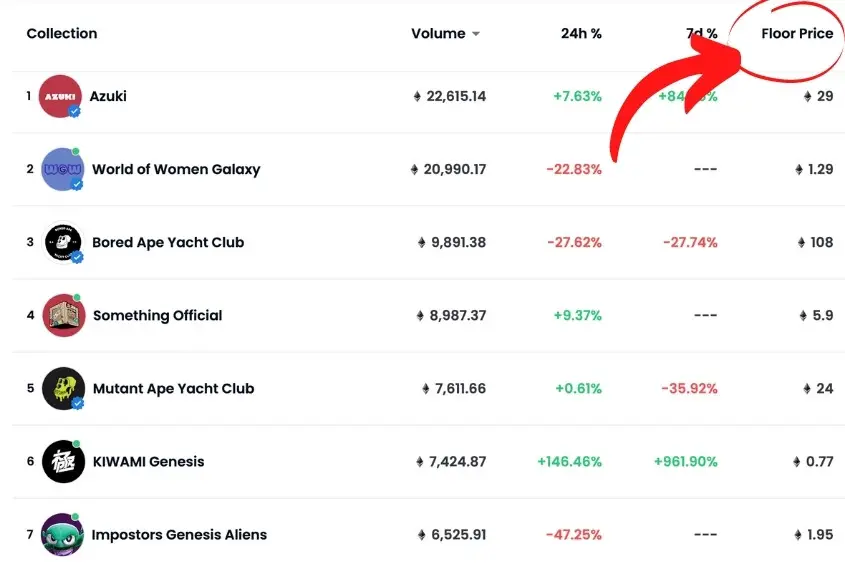
Opensea.io
Notably, an NFT’s floor price is separate from its mint price. The mint price is how much it initially costs to buy an NFT. The floor price is developed on the secondary market and as a result, is determined by the market, not the creator.
Right after an NFT is minted, the floor price is generally higher than the mint price as people are trying to flip them for a profit. That said, it’s not uncommon for the floor price to increase significantly post-mint, followed by a sharp decline sometime after.
It’s fair to say that an NFT’s floor price is a direct indicator of how the current market values a specific NFT or collection.
Below are different floor price scenarios that you should be aware of.
Current floor price
The current floor price is generally what people base their buying and selling decisions on. Of course, real-time floor prices are always fluctuating for various reasons and can change by the second.
Declining floor price
- The NFT is a scam (rug pull)
- The brand made a decision that collectors don’t agree with
- The token’s utility expired or has been claimed
- There are no new developments or the project has gone static
It’s important to research why an NFT’s floor price is decreasing. If you find that something negative has occurred and holders are hesitant to keep their money invested, consider selling yours before it becomes completely worthless.
However, if there aren’t any indicators that an NFT project has done something to negatively affect the brand, the more likely reason is that people are impatient, and are probably pulling their money to go invest in other projects. These people are referred to as “paper hands”.
Increasing floor price
If an NFT’s floor price is on the rise, this can be a good thing for many reasons. Some of these reasons could be:
- The brand has announced a new development or partnership
- The additional utility has been added to the NFT
- The brand has done a good job marketing and driving awareness to the collection
That said, an increased floor price isn’t always a good sign. If you notice an NFT’s price pumping, don’t buy into it immediately.
Again, take time to research why it is pumping. Ensure that whatever caused the increase is sustainable and not just a quick hype, unless you’re planning to flip your NFT instantly for a profit.
Moreover, an increase in price isn’t always the best time to buy an NFT since you’re paying more.
Generally, when the floor price dips is when you‘d would want to buy into a project—assuming the price dip isn’t the result of something negative that occurred.
How Is NFT Floor Price Calculated?
NFT floor price is calculated by the holders. Whoever lists their NFT for the lowest price sets the floor. Collectors can change the floor price by buying an NFT from the floor. A common tactic to raise the floor price is called a floor sweep—where someone buys multiple NFTs to increase the floor.
As for how the floor price is determined, there are several factors that play a role.
Demand for the NFT
Demand for an NFT is an obvious factor when determining an NFT’s floor price. The more demand there is for an NFT, the higher the floor price will be. If there is minimal demand, expect the market to set the price lower.
Serial entrepreneur and Web3 innovator, Gary Vee, has made many comments about supply and demand in the NFT market. Focus on demand before you ever worry about supply, that goes for both buyers and sellers.
NFT’s utility/value
Many NFTs in the early market provide little to no actual value to holders, and as a result, the floor price decreases over time. Creators that use NFTs to provide real value and utility to their holders ultimately experience a higher floor price than NFTs that offer no value.
That’s why it is so important to ask yourself why you’re buying an NFT in the first place. Does it provide you with some sort of value or real-world utility? Or are you buying it because of the hype?
Reputation of the brand/creator
When someone that is well-known releases an NFT, it tends to have a higher floor price. This is because the trust between the creator and community has already been created, versus someone new to the market who is largely unknown and has to gain trust.
That’s not to say that all well-known brands and creators NFTs’ maintain a premium floor price.
Collaborations
Collaborations are a legit reason for an NFT’s floor price to be high. For example, if Beeple and XCopy—two well-respected artists in the NFT space—come out with a collaboration piece, you could expect the floor price to be higher and maintain a hefty price on secondary markets because of their reputation and popularity.
Pros and Cons of Buying NFTs at Floor Price
Buying NFTs at their floor price come with both pros and cons, let’s take a look at each.
- You’re buying it at the cheapest price
Since the floor price is the lowest amount of money you need to spend to get an NFT from a certain collection, you can rest easy knowing you’re getting the best “Buy Now” price possible.
Moreover, the floor price simplifies budgeting. By viewing the floor price you can quickly tell if an NFT is within your budget or not.
- Potential to flip NFTs for a profit
Depending on when you buy an NFT there’s always a potential to flip it for a profit. Generally right after an NFT collection sells out, the floor price will be lower, and can steadily increase from there. This means if you buy early enough you might be able to flip your assets for a profit thereafter.
- The floor price could still decrease
- You could make a bid lower than the floor price
Although the floor price is the lowest “Buy Now” price, that doesn’t mean you can’t get an NFT for even cheaper. If you want to buy an NFT below its floor price, try placing a bid. More often than not, sellers are willing to accept a bid as long as it’s within 10-20% of the floor price.
What Is an NFT Floor Sweep?
A floor sweep is when a collector buys all the NFTs at the floor price. The aim of a sweep is to increase the floor and entice others to buy. Also, this could be a sign that a buyer has faith in a particular NFT collection and is taking advantage of the low price before it increases.
Oftentimes a floor sweep is done by a “whale”, which is industry jargon for people who have a lot of money to spend.
Frequently Asked Questions
Should I buy an NFT at floor price?
Yes, if you want a certain NFT the floor price is the most budget-friendly option. To avoid buying too high, check the collection’s analytics beforehand to see how the floor price has been holding up.
What does it mean when an NFT floor price drops?
If the floor price drops this could be a sign that the hype is wearing off or an unfavorable event has occurred leading collectors to believe an NFT is worth less.
Can you sell NFT under floor price?
Yes, if you list your NFT for less than the current floor price then your listing becomes the new floor price.
How do you know if the floor price of an NFT will go up?
If a brand announces something big such as a collaboration or added utility that brings more value to holders, you could see the floor price increase.
NFT Floor Price: What Is It?

You can take into account a number of factors when determining the intrinsic worth of a non-fungible token (NFT) in a collection. One of these is the floor price, and it is typically expressed in cryptocurrencies or stablecoins.
The number represents the lowest price a seller is willing to accept for an NFT in a specific collection. However, the value of floor prices is a little more complicated, and the metric can be used to inflate a collection’s popularity.
The floor price is frequently a good place to start when determining how well-liked an NFT collection is and how its perceived value changes over time. Collections with a higher floor price may be more well-liked, whereas drops in the floor price may indicate that a project is losing support.
For example, the floor price for an NFT in the massively popular Bored Ape Yacht Club (BAYC) collection on OpenSea in December 2022 is 74.7 ETH, or approximately $89,450. A collection’s floor price may differ significantly depending on the platform; for instance, on Rarible, BAYC’s floor price is 72 ETH (or around $86,200).
Numerous NFTs with rare attributes will sell for more than the floor price since the floor price establishes the threshold for an NFT’s value inside a collection. Ape #8552, which has uncommon characteristics including gold fur, sold for 95 wrapped ether (wETH), or about $241,470 at the time, in July 2021.
The difference reveals a characteristic of non-fungible tokens: Each digital asset is distinct and can sell for a variety of prices depending on its rarity traits or other unique attributes, even though they may be part of a collection. Floor prices may fluctuate according to changes in the market.
Additionally, The term “floor price” is sometimes applied to NFTs classified by trait. As a result, someone can claim that the floor price for a gold Ape is higher than other prices, and so forth.
Finding the floor price for a collection is not too difficult. You can click on a specific collection on an NFT marketplace, and it will display the floor pricing information alongside the collection’s overall sales volume and the best offer received from a buyer.
Is the floor price metric reliable?
Simply said, the floor price establishes the lowest possible asking price for a specific NFT collection. But that doesn’t mean that collectors will buy at that price, or that if you buy an NFT, it will actually be worth the floor price.
For example, the floor price for Tamadoge Common, an NFT project that was launched in October 2022, was 200 ETH (about $311,500) on October 24, 2022. With that asking price, it was clear that the NFT owners would not sell their tokens for less than 200 ETH. Only 12 ETH were being traded at the moment, which indicated that no one was ready to match the floor price.
Do these figures imply that a Tamadoge Common NFT was worth 200 ETH? Actually, no. Even if you purchased it, all the market knows is that you believed it to be worth 200 ETH at the time. If you wish to sell, however, you might have trouble finding a buyer willing to pay that amount.
The best offer price, or the highest price other traders are prepared to pay for an NFT in the collection, is also important to collectors. This amount, which functions similarly to a floor price, is regularly adjusted to reflect the most recent highest offer made by a prospective buyer. In a cryptocurrency trade, the spread is similar to the difference between the best offer price and the floor price.
Keep in mind who sets the floor price
It’s crucial to remember that only people who own NFTs in a collection are permitted to decide on the floor price. The ones who determine the floor price are not always trustworthy judges of value. They might be attempting to trick customers, in fact.
NFT owners may collaborate to raise a collection’s floor price artificially by refusing to sell for less than a predetermined amount. For instance, a group of owners may deceitfully raise the floor price of a specific NFT collection if they agreed not to sell their NFTs for less than 100 ETH, despite the fact that this amount is artificially inflated above the collection’s true value.
To conclude, one of the key metrics for determining the value of an NFT collection is the floor price. But we must never rely on it solely. Considering how unstable the ecosystem is, determining the fair value of NFTs is a difficult undertaking.
For more information, join our Discord community: https://discord.gg/GM3U44e6PG
Disclaimer: The information herein is for educational purposes only and should not be considered financial, investment, or trading advice. Please conduct your own research and due diligence before making investment decisions. You understand that you are using the Information provided at your own risk.
What Is An NFT Floor Price?
The floor price is the lowest-priced NFT within an NFT project.
Floor price is one of the key metrics collectors and investors consider when evaluating the intrinsic value of an NFT.
If you’ve ever been surrounded by NFT enthusiasts, you’ll likely hear the term “floor price” being thrown around in the conversation.

Every NFT is unique and features different attributes that make it rare or sought after. These attributes also make it difficult to determine the precise value of an NFT.
While tangible assets like artworks or physical collectibles like playing cards have defined values, collectors and investors looking to buy NFTs may have a hard time deciding whether an NFT is worth their money. This is where NFT metrics, such as floor price, come into play.
This article will explain what a floor price is, how they are calculated, what to look out for and where you can find it on Binance NFT .
What Is An NFT Floor Price?
The floor price refers to the lowest-priced NFT within a collection and is one of the most widely used metrics collectors use to evaluate a project.
For example, the floor price of a Rh!noX NFT at the time of writing is 816.92 USD. This means if you want to buy a Rhi!noXNFT, 816.92 USD is the cheapest option you have to get in on the project.
How is the Floor Price Calculated?
The people who own an NFT within a project set up floor prices – the more popular an NFT project gets, the higher the floor price. A sudden reduction in a project's floor price may suggest that an NFT project is losing traction.
Interested in learning more about other NFT evaluation metrics? Read more about How to Assess the Value of an NFT.
What Does Sweeping the Floor Mean In The NFT Space?
Generally, “Sweeping the floor” refers to buying digital assets in bulk, specifically assets that are part of a collection.
In the NFT space, sweeping the floor can be applied to both project owners and buyers. If project owners sweep the floor, they purchase all of their NFTs at the floor price. When buyers sweep the floor, it either means they bought all the available NFTs in the project or many of them. Both of these indicate a potential manipulation of the floor price.
How To Avoid Floor Price Manipulation
While buying the floor may be a solid starter strategy for newcomers joining an NFT project, the floor price can be manipulated.
It's not uncommon for newly minted NFT projects with high potential to be aggressively bought by a person or a group to drive up demand artificially. After the sweep, the buyer(s) can sell these newly acquired NFTs at a higher floor price — similar to how scalpers purchase event tickets and resell them at a higher price. Likewise, be mindful of projects without significant communities where the NFTs have been ‘swept.’ In instances such as those, the project could have arranged a sweep to raise the collection’s floor price and overall value.
To avoid falling into floor prices manipulated by a sweep, always review the transaction history of the NFT you want to purchase and DYOR to assess the project’s long-term value. Join their Discord and Telegram groups; see if their communities are legitimate, such as their followers on social media, to assist in decision-making around NFT investment.
To learn how to protect yourself from NFT scams, check out our article on Common NFT Scams & Safety Tips 2022 .
Where Can You Check The NFT Floor Price Chart & History On Binance NFT?

You can easily locate the floor price of an NFT collection on Binance NFT Marketplace in two ways. One way is to head to the Top Collections under Ranking where you can see a list of trending NFT collections and their floor price.
If you are looking for the floor price of a specific collection, simply enter the name of the NFT collection in the search bar and you’ll see the floor price visibly displayed at the top. Additionally, you can also see the live changes in floor price on the Binance NFT marketplace, as shown by the percentage change.

Conclusion
Market forces primarily determine the value of NFTs, and it's impossible to predict the future of the NFT space with certainty. However, you can increase your chances of success by using metrics such as floor price and doing your due diligence to guide your buying strategy.
Ready to dive into the world of all things NFT?
NFT collectors and traders can discover a variety of NFTs on Binance NFT — the ultimate marketplace where you can find NFTs from everyday creators and premium auctions to Mystery Boxes from top artists and more.
Want to keep up to date on our weekly IGO drops and exclusive Mystery Box releases? Follow Binance NFT on Twitter and Telegram !
Read the following helpful articles for more information:
DISCLAIMER: NFTs are an emerging asset class that is still evolving. The information in this article should not be construed as investment or financial advice. Always do your own research before making any decision to buy, sell or trade NFTs.