Quantum cloud что это
Внимание!
Регистрация на сайте и вход осуществляются через конференцию.
Для регистрации перейдите по ссылке, указанной ниже. Если у вас уже есть аккаунт в конференции, то для доступа ко всем функциям сайта вам достаточно войти в конференции под своим аккаунтом.
Данный сервис работает пока только для зарегистрированных пользователей.
Регистрация займет у вас всего 5 минут, но вы получите доступ к некоторым дополнительным функциям и скрытым разделам.
Соблюдение Правил конференции строго обязательно!
Флуд, флейм и оффтоп преследуются по всей строгости закона!
Комментарии, содержащие оскорбления, нецензурные выражения (в т.ч. замаскированный мат), экстремистские высказывания, рекламу и спам , удаляются независимо от содержимого, а к их авторам могут применяться меры вплоть до запрета написания комментариев и, в случае написания комментария через социальные сети, жалобы в администрацию данной сети.
Easy Crypto Mining Tool For Beginners
You don’t have to be Mining Expert,
but we can Mining Safely and Stably together!
QuantumCloud is a mining program designed for mining beginners. Since 2018, we have helped a large number of beginner users to join the ranks of mining. No software and hardware setting process, no tedious KYC verification procedures of the cryptocurrency exchange, just download the QuantumCloud program, the program will directly help you adjust the best settings of the hardware, it won’t hurt the hardware, also won’t affect the best performance of playing games.
QuantumCloud users only need to use existing hardware resources, do not need to invest in any additional mining equipment to worry about the cost of the problem, as long as turn on your computer, you can start mining to earn passive income easily!
We strictly require information security. In addition to complying with Taiwan’s Personal Data Protection Law, the program has passed rigorous, long-term reliability and stability testing. We are dedicated to providing users with a safe and stable use environment through the control of high-level security.
Since 2018, tens of thousands of users around the world have registered and used the QuantumCloud program. If you want to know more, please click FAQ!
Quantum Cloud Computing Platforms

Q uantum computing infrastructure refers to the hardware and software systems that are used to build and run quantum computers. This includes the physical devices that make up the quantum computer, such as qubits (the basic units of quantum information) and the devices used to control and manipulate them, as well as the software and algorithms that are used to program and run quantum computations. Building and maintaining a quantum computing infrastructure can be challenging due to the complexity and fragility of the systems, and the need for specialized expertise in both physics and computer science.
The history of quantum computing infrastructure can be traced back to the early days of quantum mechanics in the 1920s and 1930s. The basic principles of quantum computing were first proposed in the 1980s by Paul Benioff and Yuri Manin, but it wasn’t until the 1990s that the first functioning quantum computers were built. Early quantum computing experiments were primarily focused on demonstrating the principles of quantum computing, rather than on building useful computational devices.
In the early 2000s, several companies, including D-Wave and IBM, began to develop more advanced quantum computing systems, with a focus on building devices that could be used for practical applications. The first commercially available quantum computing systems were made available in the 2010s, but they still had very limited capabilities.
In recent years, significant progress has been made in the field of quantum computing. Advancements in qubit technologies and improvements in control systems and algorithms have enabled the development of quantum computers with greater capabilities and more qubits. This in turn has led to the creation of powerful quantum computing hardware and software infrastructure.
As quantum computing is getting explored very fast with some large players like IBM, Google, Microsoft and IonQ, as well as a number of startups, working to develop new technologies and improve existing ones, the landscape of quantum computing infrastructure is likely to continue to evolve rapidly in the coming years.
1. IBM Q EXPERIENCE: IBM (QUANTUM CLOUD PROVIDER)
IBM Q provides access to quantum hardware as well as HPC (High-performance computing) simulators. These can be accessed programmatically using the Python-based Qiskit framework, or via a graphical interface with the IBM Q Experience GUI.
The IBM Quantum Composer and the IBM Quantum Lab form an online platform allowing public and premium access to cloud-based quantum computing services provided by IBM Quantum.
Qiskit is an open-source software development kit for working with quantum computers at the level of circuits, pulses, and algorithms. It provides tools for creating and manipulating quantum programs and running them on prototype quantum devices on IBM Quantum Experience or on simulators on a local computer.
2. GOOGLE QUANTUM AI: GOOGLE (QUANTUM CLOUD PROVIDER)
Google Quantum AI is advancing the state of the art of quantum computing and developing the tools for researchers to operate beyond classical capabilities.
The Quantum AI Lab was established by Google Research in May 2013. The Quantum Artificial Intelligence Lab (also called the Quantum AI Lab or QuAIL) is a joint initiative of NASA, Universities Space Research Association, and Google (specifically, Google Research) whose goal is to pioneer research on how quantum computing might help with machine learning and other difficult computer science problems.
3. XANADU QUANTUM CLOUD: XANADU (QUANTUM CLOUD PROVIDER)
Xanadu Quantum Technologies develops cloud accessible photonic quantum computers and develops open-source software for quantum machine learning and simulating quantum photonic devices.
Xanadu’s hardware efforts have been focused on developing programmable Gaussian boson sampling (GBS) devices. GBS is a generalization of boson sampling, which traditionally uses single photons as an input; GBS uses squeezed states of light.
4. FOREST SDK: RIGETTI COMPUTING (pyQuil, quilc, and qvm)
The Rigetti Forest Software Development Kit includes pyQuil, the Rigetti Quil Compiler (quilc), and the Quantum Virtual Machine (qvm).
Rigetti Computing is a Berkeley, California-based company — offers its Quantum Cloud Services (QCS), With QCS, its quantum processors (QPUs) are tightly integrated with classical computing infrastructure and made available over the cloud.
Forest SDK is a set of software tools that allow individuals to write quantum programs in Quil, then compile and run them via QCS or a simulator.
5. AMAZON BRAKET: AWS (CLOUD SYSTEM PROVIDER)
I always think of Amazon Cloud, or AWS, as a family of computing services (Combo Pack). If I want to deploy any solution, the first thing that comes to mind is AWS.
Amazon Braket, a fully managed service that helps users get started with quantum computing by providing a development environment to explore and design quantum algorithms, test them on simulated quantum computers and run them on your choice of different quantum system hardware technologies.
Amazon Braket empowers users to research quantum computing algorithms, test different quantum hardware, build quantum software faster, as well as explore industry applications.
It’s amazing to see their capabilities:
· Amazon Braket provides access to quantum hardware based on superconducting qubits from Rigetti.
· Amazon Braket provides access to ion-trap quantum computers from IonQ.
· Amazon Braket provides access to Rydberg atom-based quantum computers from QuEra Computing
· Amazon Braket provides access to photonic quantum computers from Xanadu.
6. AZURE QUANTUM: MICROSOFT
Azure Quantum is the cloud quantum computing service of Azure, with a diverse set of quantum solutions and technologies. Azure Quantum ensures an open, flexible, and future-proofed path to quantum computing that adapts to your way of working, accelerates progress, and protects technology investments..
Designed as an open ecosystem to write and run code on a diverse selection of today’s quantum hardware, Azure Quantum gives people the flexibility to use their preferred development tools with support for Cirq, Qiskit, and Q#.
7. QUANTUM INSPIRE: QUTECH (QUANTUM CLOUD SERVICES)
Quantum Inspire by Qutech was launched in May 2020 by Minister Ingrid van Engelshoven and European Commissioner Mariya Gabriel and is probably the least known quantum cloud computing supplier offering services that can proudly boast as being the first platform in Europe to provide cloud based quantum computing to two hardware chips.
Quantum-Inspired Optimization algorithms exploit some of the advantages of quantum computing on classical hardware, providing a speedup over traditional approaches. Quantum-inspired algorithms are classical algorithms where you classically emulate the essential quantum phenomena that provide the speedup
Quantum Inspire is a prototype full-stack quantum computer. It serves as a training and education platform, a test-bed for application development and as an invitation for co-development and collaborative R&D of quantum computers.
8. FORGE: QC WARE (QUANTUM CLOUD PLATFORM)
QC Ware Forge Forge, QC Ware’s cloud services platform, enables large enterprises and public-sector organizations to start building quantum skills and prepare for the potential disruption that quantum computing will bring to the market in the near future..
Built for turn-key algorithm implementations for data scientists, financial analysts, and engineers, its circuit building blocks system also allows for the creation of users’ own algorithms.
Future of Quantum Computing Platforms
The future of quantum computing platforms is likely to see continued progress and advancements in a variety of areas. Some of the key areas of focus for the development of quantum computing platforms include:
i. Increasing qubit count and quality: One of the main challenges facing quantum computing is the difficulty of building and maintaining large numbers of high-quality qubits. As the number of qubits in a quantum computer increases, it becomes more powerful and capable of running more complex algorithms.
ii. Improving quantum error correction and fault tolerance: As quantum computers are still very fragile, error correction and fault tolerance are crucial to their operation. Researchers are working on developing new techniques for detecting and correcting errors in quantum computations.
iii. Development of new quantum algorithms: With the advent of more powerful quantum computers, the development of new quantum algorithms will become increasingly important. Algorithms will be developed which will be useful for specific fields like AI, Drug design, optimization, etc.
iv. Building larger-scale quantum networks: To achieve the full potential of quantum computing, it will be necessary to connect multiple quantum computers together to form large-scale quantum networks. This will enable quantum distributed computing, where multiple quantum devices will work together.
v. Making quantum computing more accessible and user-friendly: As quantum computing becomes more powerful and capable, it will be important to make it more accessible to a wider range of users. This will include the development of more user-friendly software and programming languages, as well as the creation of cloud-based quantum computing services.
All these advancements will allow quantum computing to be integrated into practical real-world problems and in various fields of applications. The world is yet to see the full potential of Quantum computing. Let’s wait for more faster computing engines.
Quantum computing turns into accessible services with the cloud-based quantum computers
Quantum cloud computing is a field that emerged with the convergence of quantum computing and cloud computing, two of the most influential technologies of our time. In the simplest terms, quantum cloud computing enables quantum computing resources to be available over the cloud.
Quantum computers compute differently, allowing them to function at much greater speeds and with far more complex calculations than conventional computers. The capacity of quantum computers to accelerate considerably faster is because they employ quantum physics in their processing power. Users utilize these quantum-powered computers over the internet through cloud computing, thanks to the emergence of quantum cloud computing.
What is quantum cloud computing?
Quantum cloud computing allows organizations and academics to access quantum computers via the cloud. Users can now use a wide range of quantum cloud computing services. They are employed to solve tough issues that require powerful computing. The architecture and performance of different quantum cloud computing services vary.
The current state of the quantum cloud computing
With the technology developing at a breakneck pace, huge firms like IBM, Google, Microsoft, and Amazon are on track to create quantum cloud computers. They use quantum computers with cloud computing technologies that a network may access without needing a physical quantum computer. It implies that individuals as basic users will soon be able to utilize quantum computers in the cloud. They are making the quantum computing experience more accessible than ever before.
However, with the advancement of technology and the development of new technologies, many individuals will be unable to utilize such gadgets owing to their complexity, negatively impacting people’s learning rates in quantum computing.
According to the 2020 test study “Cloud Quantum Computing Concept and Development: A Systematic Literature Review“, the IBM quantum cloud computer is more beginner-friendly and opens more options and learning strategies for the users while giving a better processing time than others.

How is quantum cloud computing used?
Quantum computing is a new field that has yet to be widely commercialized. Some tech companies have begun guiding how businesses may utilize this technology in the future. For most firms, taking advantage of quantum computing on the cloud appears to be the most viable option.
Quantum cloud computing allows users to connect directly to emulators, simulators, and quantum processors. Vendors provide programming languages, tools, and documentation for implementing quantum computing applications in various ways.
Businesses and researchers mostly use quantum cloud computing to test their quantum algorithms. Quantum algorithms are initially created on conventional computers and then tested in real quantum computers via the cloud.
Quantum computing has a high cost and technical barrier to entry; therefore, its deployment is limited. Quantum computing systems are costly and time-consuming to develop, deploy, manage, and maintain. Companies that already use these technologies employ cloud-based quantum computing via their build platforms.
There is a lot of research and development in this area. Quantum cloud computing is used to study, experiment, and test quantum theories. Teaching is another application of quantum cloud computing. Quantum physicists can easily grasp their ideas and conduct research without having access to a physical quantum computer in their labs.
Nonlinear problems with many solutions benefit from quantum computing, which has the edge over conventional computing in such circumstances. Suppose a multi-parameter nonlinear issue that would take years to solve using ordinary computers is the obstacle to progress. In that case, it’s time to design algorithms and put them through their paces in the cloud.
How does quantum cloud computing work?
Quantum cloud computing services are relatively new. Their offerings are similar to early virtualization solutions but for quantum processing. A typical quantum cloud computing platform for quantum software testing works more or less as described below:
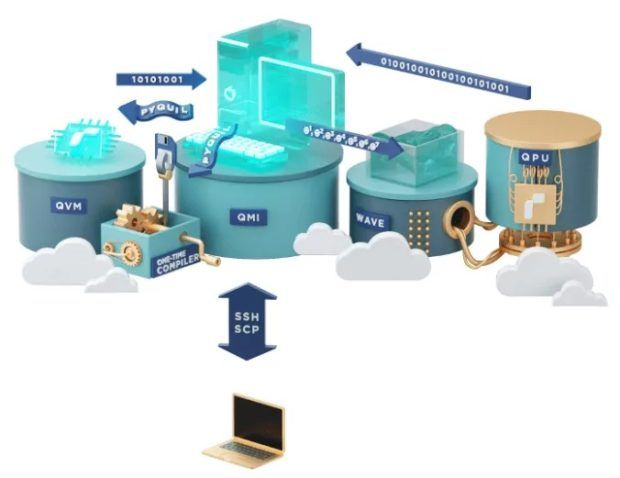
Quantum cloud computing connects developers’ conventional computers to the quantum machine image (QMI). QMIs are virtualized programming and execution environments for creating and executing quantum software programs.
The programmed code is run on quantum virtual machines (QVMs). QVMs are quantum machines that execute and generate a waveform on quantum processors. The quantum machine image communicates with the quantum processing unit (QPU), a quantum chip with interconnected qubits. Waveforms are used to program these qubits. The data received by the QMIP is processed and transmitted back to the traditional computer through the QPU.
Quantum development
Although quantum computing is still in its infancy, it may significantly impact many areas as long as the implementation and error correction improve. This cutting-edge technology will reach a threshold with more people getting involved and working together. It is possible to test quantum coding and software through emulators and simulators.
Using a quantum computer to design and test quantum algorithms will be considerably faster than traditional computing because all the necessary elements of such calculations can be combined in one place. Quantum cloud computing offers a direct interface to quantum circuits and quantum chips, enabling the final testing of quantum algorithms.
Quantum cloud computing has opened the door for users to make enhancements to quantum computing. Companies and academics may practice using quantum computing on the cloud without waiting for quantum computing technology to mature and become widespread.
The quantum computing market is anticipated to reach $280M, according to MarketsandMarkets research.
Top quantum cloud computing vendors
Quantum computing attracts interest from big names in science and tech, the military sector, specialized firms, and government organizations. While technology giants are developing their quantum systems, they may collaborate with seasoned startups.
Here are some of the quantum cloud computing providers:
• IBM Q Experience
In 2016, IBM created a quantum network called the IBM Q network. Since then, IBM has been one of the leading players in quantum computing. Qiskit is a cloud-based software development kit that allows you to connect to IBM Q (an open-source quantum computing program).
• Microsoft Azure Quantum
Microsoft offers QDK, a quantum script language based on Q# for quantum computing development. Azure Cloud supports quantum computers developed by Microsoft’s partners. Microsoft has also developed its quantum system called Station Q. The topological qubit method for producing stable quantum bits is a way that Microsoft has developed to create large quantities of quantum computers.
• Amazon Braket
Amazon announced the Bracket at the end of 2019, saying it began quantum computing research. Amazon provides the whole system as a service by combining quantum computing with the cloud. Amazon also established the Amazon Quantum Solutions Lab, a physical laboratory.
• Google’s Quantum Playground
Quantum Playground is a 3D quantum state visualization tool for designers. It also includes a user interface, programming language, and 3D quantum state display. Google claimed quantum supremacy in late 2019 by utilizing the 54-qubit Sycamore processor.
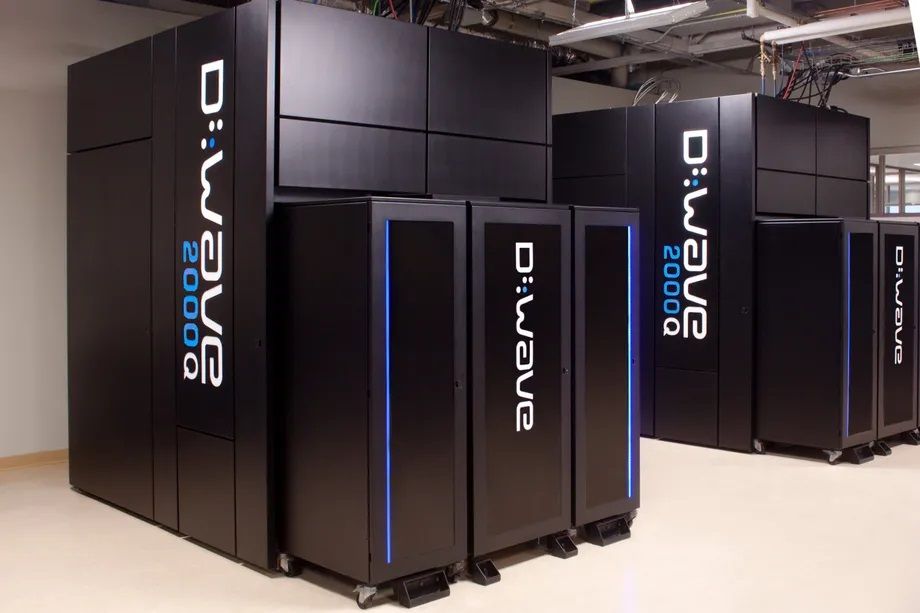
• D-wave Leap
D-wave, based in Vancouver, Canada, is the first to market a commercially available quantum computer. D-wave is another young firm that has attracted more than $200 million in investment. D-wave systems recently announced free access to its quantum system over Leap cloud service.
• Rigetti Forest
A quantum computing startup Rigetti is a firm that makes tools for the field. Forest is their product, which includes a tool kit for quantum computing. A programming language (Rigit), development tools, and example algorithms are included.
• Xanadu
Xanadu launched the world’s first photonic quantum cloud platform with 8 and 12 qubits. The technology is said to be being tested by companies like Creative Destruction Labs, Scotia Bank, BMO, and Oak Ridge National Laboratory (ORNL).
The future of quantum cloud computing
According to Gartner’s Martin Reynolds, cloud-based quantum computing is more difficult to deploy than deep learning. As a result, the learning curve will be steeper, and the ramp-up slower. Quantum computers need specific room conditions significantly different from how cloud providers build and maintain their data centers.
Quantum computing also necessitates the development of new arithmetic and logic skills in software engineers. This is tough for them since conventional digital programming methods are unavailable. IT teams must develop specialized abilities to understand how to implement quantum computing in the cloud and a precise understanding of algorithms and hardware needed to make it function.
The cloud, despite its flaws, is an excellent method to utilize quantum computing. Quantum computing can achieve great computational performance with little I/O. Cloud companies will be among the first providers of quantum-as-a-service since they have both technological capabilities and a large customer base. They will look for the best software development and deployment stacks. Quantum cloud computing will grow as wide as AI in the next years if some real issues can be overcome.