Внебиржевые сделки(блок-трейды) на фьючерсах биржи CME.

На сайте биржи www.cmegroup.com/clearing/trading-practices/block-trades.html дано следующее определение Block-trade: это крупная фьючерсная (опционная) сделка, заключенная в частном порядке и исполнена отдельно от публичного рынка(т.е. не на открытых торгах через стакан), а напрямую между участниками. Предназначена для удовлетворения потребностей институциональной торговли. По правилам такая сделка должна быть зарегистрирована на бирже в течение 15 мин. после её заключения. Есть несколько разновидностей блок-трейдов: https://www.cmegroup.com/education/courses/market-regulation/block-trades/block-trades-tas-tam-and-btic.html
Здесь datamine.cmegroup.com/#/datasets/cme.block указано, что данные о таких сделках можно покупать у самой биржи. 1500$ в месяц за четыре биржи CME Group, или по 750$ каждая в отдельности. Почти за даром.
Но их можно вычислять из биржевых тиковых данных, которые стоят на много дешевле(смотрим мой предыдущий топик). Фрагмент тикового файла Time&Sales со сделками по фьючерсу на нефть CL, майский контракт, от 13.04.2021:
Time Price Vol Total
20210412 180000 59.64 1 1
20210412 180000 59.64 2 3
20210412 180000 59.64 2 5
20210412 180000 59.64 2 7
20210412 180000 59.64 2 9
.
20210413 165959 60.47 1 306697
20210413 165959 60.45 1 306698
20210413 165959 60.45 1 306699
Биржа даёт время каждой сделки (по Нью Йорку), цену, объём и суммарный объём торгов за текущую сессию. TotalVolume начинается от нуля на открытии сессии и кумулятивно увеличивается с учётом сайза каждой последующей сделки.(казалось бы зачем? Можно и самому посчитать). На закрытии сессии он составил 306699 контрактов. Этот объём мы видим на сайте биржи на дневном графике (cmegroup.com использует графики tradingview). 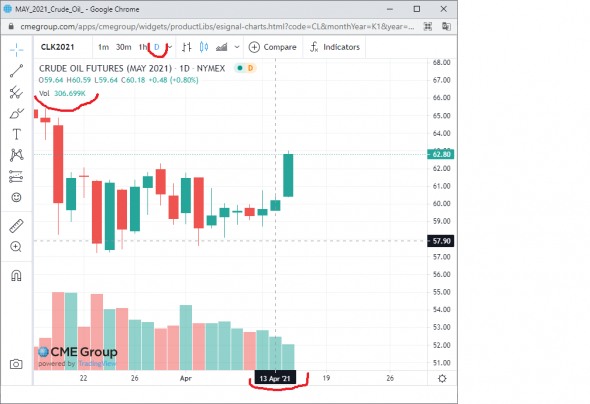
Далее, самостоятельно вычисляем TotalVolume торгов за всю сессию, суммируя объёмы всех трейдов из файла Time&Sales. Я это делаю в своей старой проге, нарисовав дневной бар из этих данных: 
И тут видим совсем другой объём — 208053. Возникает подозрение: либо данные не полные, либо просуммировал не правильно. Долго разбирался и что выяснил. Если на сайте биржи(или tradingview) на графике с более мелким таймфреймом(меньше дневного) просуммировать вертикальные объёмы всех баров за эту же сессию, так же получим 208053. На скрине ниже в калькуляторе просчитана сумма вертикальных объёмов всех шести 4-ох часовых свечей за этот день. Нужно учитывать, что дневной объём считается от клиринга до клиринга, т.е. от начала сессии по НьюЙорку в 18-00 предыдущего дня и до закрытия в 16-59 текущего дня. В 17-ом часу торги закрыты, клиринг. Если на сайте tradingview и время Московское, то всё проще — с 1:00 до 23:59 одним днём. 
Мало кто знает о таком отличии объёмов дневного и более младших таймфреймов.
Откуда разница? TotalVolume за сессию 306699, который считает и транслирует биржа, учитывает внебиржевые блок-трейды, которых в файле Time&Sales, конечно, же нет. Что это нам даёт?
20210413 120443 60.42 1 199278
20210413 120446 60.42 1 199281
20210413 120447 60.42 2 200283
В данном фрагменте тиковых данных видим что после второго трейда TotalVolume составлял 199281 контракта. Далее прошла сделка в 2 контракта, а суммарный объём увеличился на 1002 контракта. Это говорит о том, что между этими сделками биржей был зарегистрирован блок-трейд размером в 1000 контрактов. Теперь не сложно вычислить и вывести такие сделки на график.

Имеем ввиду, что здесь цене блок-трейда присваивается значение цены текущего тика из Time&Sales. Но мы не знаем, какой она была на самом деле. Настоящая цена блок-трейда может отличаться от рыночной, хотя и не значительно. Возможно, в такой информации есть некая ценность. Ну, тогда 1.5к в месяц, милости просим, покупайте данные у биржи. А некоторые блок-трейды вааще заключаются по условной цене, которая будет определена как цена закрытия текущей, ещё не закончившейся сессии. Тоесть, цена сделки в момент её заключения и регистрации ещё не известна.
Добавлю, что сделки с фьючерсами на нефть, совершаемые на открытом рынке через стакан, как правило, не сильно превышают 500 контрактов. А блок-трейды могут достигать до 5000 и более.
Аналогичным образом можно вычислять и внебиржевые DarkPool-сделки с акциями на биржах NYSE и NASDАQ.
Understanding Block Trades and How to Find Them
There are numerous signals, indicators, and news catalysts you can pay attention to when it comes to day trading. Some are based on the news, others are based on financial data, and some are based on what other traders are doing, including block trades.
Block trades are large buy or sell orders that are typically a sign of what an institution is doing to their portfolio, and can give you an idea of what stocks to keep your eye on, and maybe even trade yourself. So, how can you transform your stock trading exploits with these orders?
What are Block Trades?
Block trades are large buy or sell orders that are typically an indication of what an institution is doing to their portfolio. When hedge funds or institutional investors want to buy or sell large amounts of a security, they will do so with block trading.
Block trades technically include trades of at least 10,000 shares, but typically involve more. They can also include $200,000 in bonds.
The reason hedge funds and institutional investors use block trades is to avoid creating volatility in the volume and value. Often, those looking to block trade use an intermediary to assist instead of simply opening a traditional brokerage account.
With block trades, a blockhouse typically handles the trades. Blockhouses operate like any other brokerage firm, however, their clients are not individual investors. Instead, they handle institutions like corporations, banks, and insurance firms. Blockhouses specialize in handling large trades outside the open markets and help minimize volatility in the market.
To do this, they may break up the large order into smaller orders. Therefore, you’re not always making one massive stock trade. Additionally, blockhouses can negotiate a price for the buyer and seller.
Why Should Retail Traders Care About Block Trades?
Block trades can give you an idea of what might those managing large sums of money think about the stock. While this isn’t the only word on what Wall Street thinks about these assets, you get an idea of how the price is shifting.
Everyday retail traders can’t always know why a block trade is made, but it can give you an idea of a ticker to keep your eyes on. You might notice patterns tied to block trades and the bear or bull market. Some people might notice that one stock exchange or another is performing differently depending on the asset types, the size of these share sales, etc.
Are Block Trades Good or Bad?
There isn’t necessarily a right or wrong answer to this. A block transaction is just that—a transaction. They’re not angels or devils. From a market standpoint, since block trades happen outside the open market, once traders see that a bunch of shares are now up for sale all at once, this could bring about negative sentiment towards that underlying stock. So, a block transaction could turn out to be negative based on the perception of that transaction.
From a retail trader standpoint, block trades can be a way to gauge interest in a stock. Although it’s hard to determine whether that trade will perform positively or negatively, either way, attention is being brought to the name of that company. You can use block trades along with other indicators as a way to determine if this is a trade you want to get in on.
How to Find Block Trades
Benzinga Pro makes it easy to find these large trades with the Signals tool to get alerts based on trading activity. All you have to do is pull up the Signals tool and make sure the block trades Signal is checked. Here, you can easily see the time, ticker, description of the block trade.
The block trade description will be something like this:
Block Trade: TICKER # OF SHARES @ PRICE
For example, at 11:04 a.m. EST on February 27th, Benzinga Pro detected the following block trade:
Block Trade: CZR 1.3M @ 12.81 at the ask
Some Signals will show at the ask, above the ask, below the bid, or at the bid. Above or at the ask shows that the investor or trader is bullish, while below or at the bid indicates a bearish move. Knowing the block size and these factors makes it easier to make wise decisions.
If the alert doesn’t mention the ask or bid, you can start watching it right away with the chart to try and guess if it was a bullish or bearish move. This might be a good time to look into the block size and decide how this
Uncover a New Block Transaction Today
Block trades are very large orders that are typically made by hedge funds or institutional investors. They are done to avoid creating market volatility, and blockhouses help investors make the trade. For the retail trader, keeping an eye on these large trades can help you see what an institution may be feeling toward a particular stock in their portfolio.
Go Deeper:
Disclaimer: Benzinga is a news organization and does not provide financial advice and does not issue stock recommendations or offers to buy stock or sell any security. Benzinga Pro is for informational purposes and should not be viewed as recommendations. Benzinga Pro will never tell you whether to buy or sell a stock. It will only inform your trading decisions. You can find our full disclaimer located here.
Block Trade: Definition, How It Works, and Example
James Chen, CMT is an expert trader, investment adviser, and global market strategist.
What Is a Block Trade?
A block trade is a large, privately negotiated securities transaction. Block trades are arranged away from public markets to lessen the effect on the security’s price. They are usually carried out by hedge funds and institutional investors via investment banks and other intermediaries, though high-net-worth accredited investors may also be eligible to participate.
The New York Stock Exchange and the Nasdaq define a block trade as one involving at least 10,000 shares of stock, or one worth more than $200,000. Most block trades far exceed these minimums.
Key Takeaways
- A block trade is a large, privately negotiated securities transaction.
- Block trades are generally broken up into smaller orders and executed through different brokers to mask the true size.
- Block trades can be made outside the open market through a private purchase agreement.
Block Trade
Understanding Block Trades
A bulk-sized sell order placed on a stock exchange may have an outsized effect on the share price. In contrast, while a block trade negotiated privately will often provide a discount to the market price for the buyer, it will not inform other market participants about the additional supply until the transaction has been publicly recorded.
Block trades not yet publicly disclosed are considered material non-public information, and the financial industry’s self-regulatory organization, FINRA, prohibits the disclosure of such information as front running.
Block trading facilities and block houses are specialized intermediaries that can facilitate block trades. Block houses are departments within brokerages that operate dark pools, private exchanges where large buy and sell orders can be matched out of public view. Block houses can also break up large trades on public markets to conceal the scope of additional supply, for example by placing numerous iceberg orders.
Block Trade Example
A hedge fund wants to sell 100,000 shares of a small-cap company near the current market price of $10. This is a million-dollar transaction on a company that may only be worth a few hundred million, so the sale would probably push down the price significantly if entered as a single market order. Moreover, the size of the order means it would be executed at progressively worse prices after exhausting demand at the $10 asking price. So the hedge fund would see slippage on the order and the other market participants might pile on, shorting the stock based on the price action and forcing the price down further.
To avoid this, the hedge fund can contact a block house for help. Block house staffers would break up the large trade into manageable chunks. For example, they might split the block trade into 50 offers of 2,000 shares, each posted by a different broker to further disguise their origin.
Alternatively, a broker could find a buyer willing to buy all 100,000 shares at a price arranged outside the open market. This would typically be another institutional investor.
Block Trade
 Block Trade
Поделиться видео // www. Investopedia. ком / термины / б / blocktrade. asp
Что такое «Блочная торговля»
Блочная торговля, также известная как порядок блокировки, представляет собой заказ или торговлю, представленную для продажи или покупки большого количества ценных бумаг. Блочная торговля включает в себя значительное количество акций или облигаций, торгуемых по договорной цене между двумя сторонами, иногда за пределами открытых рынков, для уменьшения влияния цен на ценные бумаги. В целом, 10 000 акций, не включая запасы пенни, или облигации на сумму 200 000 долларов США считаются блочной торговлей.
РАЗГРУЗКА «Блокировка торговли»
Если блочная торговля проводится на открытом рынке, трейдеры должны быть осторожны с торговлей, поскольку она вызывает большие колебания объема и может повлиять на рыночную стоимость приобретаемых акций или облигаций. Поэтому блочные сделки обычно проводятся посредником, а не хедж-фондом или инвестиционным банком, покупающим ценные бумаги, как правило, по мере того, как они будут взимать меньшие суммы.
Способ совершения блочных сделок
Блочные сделки обычно проводятся через посредника, известного как блочный дом. Эти фирмы специализируются на крупных сделках и знают, как начать такие сделки тщательно, чтобы не вызвать неустойчивый рост или падение цен на ценные бумаги. Блочные дома удерживают трейдеров от персонала, который хорошо разбирается в управлении сделками такого размера. Сотрудники предоставляют блочный дом с особыми отношениями с другими трейдерами и другими фирмами, которые позволяют компании более легко торговать этими большими суммами.
Итак, когда крупное учреждение решает начать блочную торговлю, оно обратится к персоналу блочного дома, надеясь, что они будут коллективно помогать получить лучшее предложение. После размещения заказа брокеры в блочном доме свяжутся с другими брокерами, которые специализируются на определенном типе ценных бумаг, торгуемых, а экспертные торговцы ценными бумагами заполняют крупный заказ несколькими продавцами.
Если, например, JP Morgan хочет инициировать блочную торговлю в 10 000 акций по цене 10 долларов за акцию, он обратится за помощью к блочному дому. Сотрудники блочного дома разлагают крупную торговлю на управляемые куски, в этом случае пять небольших блоков из 2 000 акций, по цене 10 долл. За акцию. Каждый из блоков будет инициирован отдельным брокером, что приведет к низкой волатильности рынка.