WTF Is A Derivation Path?
How does one address turn into UNLIMITED addresses?


Using a wallet in the land of crypto is far different than the traditional world. There are new words, new concepts, and, depending on the type of account you make, the process can be confusing. You can create a private key, a keystore file (a private key protected by a password), or a mnemonic phrase (a string of words that can access multiple private keys).
Aside from having different security features, the biggest difference between each of these is that a private key or keystore file only creates one account. Creating a mnemonic phrase gives you control of many accounts, all accessible with that same phrase.
How does a single phrase create more than one address?
A mnemonic phrase — otherwise known as a “Hierarchical Deterministic Wallet” — generates addresses by taking the phrase and combining it with a piece of information called a derivation path. Together, they create any number of accounts, using Complex Math™ aka cryptography.
So, what is a derivation path?
Before we try to understand what a derivation path is, let’s look at what the word derive means. The standard definition of derive is “to obtain something from a specified source.” In a mathematical context, the definition is a bit more specific: “To obtain [a function or equation] from another by a sequence of logical steps, for example by differentiation.”
This, put more simply, is to obtain something, from something else, in a very specific way. “Derivation Path” is just a fancy way of saying “this is the thing you use to get all your accounts from your mnemonic phrase.”
The anatomy of a derivation path
This is what a derivation path looks like: m/44'/60'/0'/0'/0
Each of the numbers in that sequence play a part and each changes what the private key, public key, and address would be. If you’re interested in learning a little more about the technical aspects of this, you can read more here. The most important takeaway is that if you want the next address from a phrase, you just increase the last number by one:
(In programming, you start counting at 0. 0…1…2…3… rather than 1…2….3….This different than how we count in our day-to-day lives, so it can be confusing at first.)
History lesson: Addresses in Bitcoin (UTXO) versus Ethereum
Bitcoin and Ethereum operate differently whenever you send a transaction. On the Bitcoin network, when you send coins from one address to another, you typically send your entire balance. Part of what you send goes to a receiver address, and the remainder goes to a secondary, or “change,” address. This is called “UTXO” or “Unspent Transaction Output.” In order to know the balance, you actually have to add up all the UTXO’s. A technical explanation of this can be found here.
Ethereum, on the other hand, uses an account-based system, which operates more like a traditional banking system would. This means that each account, or address, directly spends or receives value. There are several advantages to using this system, such as ease of tracing transactions and how double spending is prevented. It also allows for smart contracts to hold a balance in the same way a “normal” account would. Because of this, each Ethereum address can have a balance, contract code, and data storage, and the system allows the balance to change for any address with each transaction.
The complexity and robustness of the Ethereum Virtual Machine, which executes the contract code, is more easily served by the account method. Having the value, contract, and storage information bound to a single address saves space in the current state of the chain. A more in-depth article on these differences can be found here.
Regardless, the reason behind the mnemonic phrase, derivation path, and seemingly unnecessary complexity comes from Bitcoin. The specification was made before Ethereum even existed and helped solve a very specific problem: it allowed you to send bitcoin to the receiver and send all the “change” to a new address that you controlled without having to create, backup, and secure a new private key each time. Nifty, right?
Derivation paths and HD Wallets in general are a great example of how, slowly but surely, we are improving how we interact with the blockchain. You might have seen one when accessing a wallet via mnemonic phrase or when using a Ledger or a Trezor. Hopefully when you look at a derivation path now, it’s less meaningless numbers and more awe-inspiring technology.
Derivation paths in Exodus
Need to know the derivation path for one of the assets in your Exodus wallet? Look no further! This article explains what a derivation path is and includes a list of paths for most of the assets that Exodus supports.
Need a crypto wallet that gives you full control of your assets? You can download Exodus here.
In this article:
What are derivation paths?
Exodus is a hierarchical deterministic (HD) wallet. HD wallets use the 12-word secret recovery phrase together with the derivation path to generate private keys by cryptography.
You can think of these private keys being in the structure of an inverted tree, in which an infinite number of child keys are created, or branch out, from their parent keys.
This makes it possible for your Exodus 12-word secret recovery phrase to generate public addresses and private keys for all the assets supported in your wallet.
The derivation path is important as it sets the standard of how your public addresses and private keys are created. Basically, the derivation path is, like it sounds, the path to how your keys are derived.
Exodus, for the most part, uses BIP-44, and SLIP-0044 as the registered coin types.
What are the derivation paths used in Exodus?
Here is the list of the derivation paths used in Exodus.
| Exodus asset | Derivation path |
| Algorand (ALGO) | m/44’/283’/0’/0/0 |
| Avalanche | m/44’/60’/0’/0/0 |
| Legacy Bitcoin (BTC) address (starts with a 1) | m/44’/0’/0’/0/0 |
| SegWit Bitcoin (BTC) address (starts with a bc1q) | m/84’/0’/0’/0/0 |
| Taproot Bitcoin (BTC) address (starts with a bc1p) | m/86’/0’/0’/0/0 |
| Bitcoin Cash (BCH) | m/44’/145’/0’/0/0 |
| Bitcoin Gold (BTG) | m/44’/156’/0’/0/0 |
| Bitcoin SV (BSV) | m/44’/236’/0’/0/0 |
| BNB Smart Chain | m/44’/60’/0’/0/0 |
| *Cardano (ADA) | m/44’/1815’/0’/0/0 |
| Cosmos (ATOM) | m/44’/118’/0’/0/0 |
| Dash (DASH) | m/44’/5’/0’/0/0 |
| Decree (DCR) | m/44’/42’/0’/0/0 |
| DigiByte (DGB) | m/44’/20’/0’/0/0 |
| Dogecoin (DOGE) | m/44’/3’/0’/0/0 |
| Elrond (EGLD) | m/44’/508’/0’/0’/0′ |
| Eos (EOS) | m/44’/194’/0’/0/0 |
| Ethereum (ETH) | m/44’/60’/0’/0/0 |
| Ethereum Classic (ETC) | m/44’/61’/0’/0/0 |
| Fantom | m/44’/60’/0’/0/0 |
| Filecoin (FIL) | m/44’/461’/0’/0/0 |
| Hedera Hashgraph (HBAR) | m/44’/3030’/0’/0/0 |
| ICON (ICX) | m/44’/74’/0’/0/0 |
| *Lisk (LSK) | m/44’/134’/0’/0/0 |
| Litecoin (LTC) | m/44’/2’/0’/0/0 |
| *NANO (XNO) | m/44’/165’/0’/0/0 |
| NEM (XEM) | m/44’/43’/0’/0/0 |
| Neo (NEO) | m/44’/888’/0’/0/0 |
| *Ontology (ONT) / Ontology Gas (ONG) | m/44’/1024’/0’/0/0 |
| Polkadot (DOT) | m/44’/354’/0’/0’/0′ |
| Polygon (MATIC) | m/44’/60’/0’/0/0 |
| Qtum (QTUM) | m/44’/2301’/0’/0’/0′ |
| Ravencoin (RVN) | m/44’/175’/0’/0’/0′ |
| XRP (XRP) | m/44’/144’/0’/0’/0′ |
| *Solana (SOL) | m/44’/501’/0’/0/0 |
| *Stellar Lumens (XLM) | m/44’/148’/0’/0/0 |
| Terra (LUNA) | m/44’/330’/0’/0’/0′ |
| *Tezos (XTZ) | m/44’/1729’/0’/0/0 |
| Theta (THETA) / Theta Fuel (TFUEL) | m/44’/500’/0’/0’/0′ |
| Tron (TRX) | m/44’/195’/0’/0’/0′ |
| VeChain (VET) / VeThor (VTHO) | m/44’/818’/0’/0’/0′ |
| Waves (WAVES) | m/44’/5741564’/0’/0’/0′ |
| Zcash (ZEC) | m/44’/133’/0’/0’/0′ |
| Zilliqa (ZIL) | m/44’/313’/0’/0’/0′ |
*The assets marked with asterisks have non-standard derivation paths. This means that you might not see these funds in all wallets.
What wallets are compatible with Exodus?
Not all wallets work with the paths above. For more information, and to see a list of wallets that follow the same standard and are compatible with the derivation path used in Exodus, you can visit: Exporting individual private keys with non-standard derivation paths.
If an asset is not on the list, then at this time a compatible wallet has not been found. If you find one that works for your asset, let us know so that we can add it!
Exodus is not affiliated with any third-party platforms, external links, or any other third-party resources mentioned in this article. As such, Exodus cannot guarantee the performance of third-party products or services, or that the steps shown and the information provided will always be accurate.
Can someone explain the meaning of derivation path in wallet in plain English (such as m/44'/60'/0'/0)?
Derivation paths are related to HD Wallets or HD Keys, a type of wallet where you have a single, human readable, seed phrase that unlocks a number of accounts / addresses / private keys across any supported network. These phrases typically look like brain surround have swap horror body response double fire dumb bring hazard .
The technical specification for the most commonly used HD wallets are.
-
— HD wallets specification — the mnemonic phrase / word list / etc. piece of this puzzle. — the derivation path stuff / algorithms.
Typically you have a single private key (e.g. afdfd9c3d2095ef696594f6cedcae59e72dcd697e2a7521b1578140422a4f890 ) which allows you to access your funds in it’s matching address (e.g. 0x06A85356DCb5b307096726FB86A78c59D38e08ee ). This is a keypair.
With HD wallets you have a single seed phrase (e.g. brain surround have swap horror body response double fire dumb bring hazard ) which, via math and algorithms and code and stuff, derives multiple keypairs. An infinite number of keypairs.
Additionally, there is an insecure format of wallet known as a «brain wallet» where a person can use a single, human-readable phrase and, via math and algorithms and code and stuff, turns into a single keypair.
Okay, but wtf about derivation paths?
Brain wallets allow you to turn dogsarecool12 or brain surround have swap horror body response double fire dumb bring hazard into a single private key which is then used to access your funds and sign your transactions.
For simplicity’s sake, lets represent this as
If I were to use catsarecool10 instead of dogsarecool12 as my phrase, I would get a different keypair, different address, different account.
HD wallets are similar, but each phrase has an infinite number of keypairs or accounts that it can access. Because, unlike brain wallets, it does more complex math. For simplicity’s sake, let’s represent this as
seed phrase + XYZ + �� + ABC + & + 1 => private key
If you change any one of those pieces, the private key that you get (or derive) is is going to be different, just as it was above with catsarecool10 vs dogsarecool12 . However, since all the coders follow the same rules, the pieces that get added to the seed phrase are consistent and allow users to access the same accounts across multiple products or blockchains.
These pieces are the «derviation path»
- XYZ + �� + ABC + & + 1
The actual derivation path pieces
Full path: m/44’/60’/0’/0’/0
What each number represents: m / purpose’ / coin_type’ / account’ / change / address_index
Probably just a random way to start a string so that coders can easily tell if something is a derivation path, not you starting to type «mommy».
This is always 44′ . However, if it were decided that there were a better evolution of the HD key system, you could change it to be 45′ so that, again, coders could tell the difference between an old system and a new system.
Which blockchain are you accessing? Each blockchain has a number that represents it. Bitcoin is 0 . Ethereum is 60 . Aion is 425 . When you create a new blockchain, you apply for an unused number. You can see all the chains and their numbers here: https://github.com/satoshilabs/slips/blob/master/slip-0044.md
A number that starts at 0 and increases. A layer of separation or hierarchy. (more on that below)
Sometimes used in Ethereum, sometimes not. Was created for Bitcoin originally which doesn’t really have «accounts», it has «unspent transaction outputs». Basically you never send a part of your bitcoin holdings around—you send all your bitcoin to multiple addresses. If you have 0.75 BTC but only want to send me 0.5 BTC, you would send me 0.5 BTC and then send yourself 0.25 BTC. «Yourself» could be back to the original address or to another address you have access to (for example, the next address on the «list»). This number says «send whatever I don’t want to send to my friend to the 10th address on my list. Or the 0th address on the list (aka the address I am sending from).
Another variable to get different accounts, etc.
Seperation and Hierarchy
Some of the variables above are based on external forces, like what chain I am on. Some are chosen by the user or the wallet software, like the change variable. The account and index variables give me (or my wallet) more things to change.
For example, let’s say I want to separate my personal ETH holdings from my company’s ETH holdings. I could use m/44’/60’/0’/0’/0 for the company and m/44’/60’/1’/0’/0 for my personal.
But let’s say I want to have different addresses for.
- my personal savings
- where I receive my paycheck each week
- when I personally getting paid back by friends
- displaying publicly on my personal github for donations
- all my personal school expenses
I could use m/44’/60’/1’/0’/0 for savings, m/44’/60’/1’/0’/1 for paychecks, m/44’/60’/1’/0’/2 for getting paid back by my friend, and so forth. I could also do the same with the company accounts. Yay!
Derivation path что это
If you use a Secret Recovery Phrase or hardware wallet, you may come across the term "derivation path." In short, it specifies which private key (and thus which address) is used. A derivation path looks something like this:
Note the extra "/0" at the end of the derivation path. This number is called the address index, and is used by MyCrypto to show you all the different addresses in the list. MyCrypto follows the BIP-32 and BIP-44 specification for this.
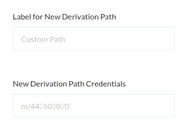
Each coin has its own base derivation path, to ensure that you get different addresses for each coin. That does not mean that you cannot use the same address for ETH ( m/44'/60'/0'/0/x ) and ETC ( m/44'/61'/0'/0/x ), but by default, these addresses are separated.
If you're interested in a full, technical explanation of how BIP-32 and BIP-44 work, please refer to this article.
Share
MyCrypto is the number one way to manage all of your Ethereum Accounts
You can always email us for one-on-one help using support@mycrypto.com
Didn't find what you were looking for? Contact Us
MyCrypto is an open-source tool that allows you to manage your Ethereum accounts privately and securely. Developed by and for the community since 2015, we’re focused on building awesome products that put the power in people’s hands.